
 Español
 Français
 Deutsch
 日本語
 한국어


Lipid-coated magnesium carbonate (magnesium oxide)
Lipid-coated magnesium carbonate (magnesium oxide) is a functional mineral ingredient designed to improve the handling, stability, and performance of magnesium-based compounds in a wide range of applications. It combines a magnesium carbonate or magnesium oxide core with a thin lipid-based surface layer, creating a modified particle that is easier to disperse, more resistant to moisture, and often better suited for use in complex formulations. This type of material is commonly developed to address the natural limitations of ordinary magnesium salts, such as poor flowability, high reactivity with water, and limited compatibility with certain hydrophobic systems.Magnesium carbonate and magnesium oxide are both widely valued for their alkaline properties, high mineral content, and usefulness in industrial, food, cosmetic, and pharmaceutical settings. Magnesium carbonate is known for its low density, good absorbency, and mild alkalinity, while magnesium oxide is recognized for its strong basicity, thermal stability, and high magnesium concentration. However, in their uncoated forms, these powders can be dusty, difficult to process, and sensitive to environmental humidity. Lipid coating helps reduce these issues by forming a protective barrier around each particle, minimizing direct contact with air and moisture.The lipid layer may be composed of fatty acids, natural waxes, glycerides, phospholipids, or other hydrophobic materials. This surface modification can significantly improve powder flow, reduce agglomeration, and enhance the shelf life of the ingredient. In addition, the coating can slow down the release of the active mineral, which may be beneficial in controlled-release formulations or when a smoother interaction with the final product is desired. The lipid surface also improves dispersibility in non-aqueous systems and may help the powder integrate more uniformly into creams, tablets, supplements, and specialty blends.In food and nutritional products, lipid-coated magnesium carbonate or magnesium oxide may be used to support magnesium fortification while improving processing efficiency. The coating can help reduce unpleasant sensory effects, such as grittiness, and can protect the mineral during manufacturing and storage. In cosmetics, the material may serve as an absorbent, bulking agent, or texture enhancer, especially in products where moisture control and smooth application are important. In industrial applications, the coated particles may be useful where controlled alkalinity, better dispersion, or improved dust suppression is required.Another important advantage of lipid-coated magnesium compounds is their improved compatibility with hydrophobic ingredients. Many formulations contain oils, fats, or waxes that do not mix well with untreated mineral powders. The lipid surface makes the magnesium particle more organophilic, allowing it to blend more easily into such systems. This can lead to better product uniformity, improved stability, and more predictable performance.Overall, lipid-coated magnesium carbonate (magnesium oxide) represents an advanced form of mineral modification that combines the functional benefits of magnesium compounds with the processing advantages of lipid surface treatment. Its enhanced stability, improved flow, reduced moisture sensitivity, and broader formulation compatibility make it a versatile ingredient for modern product development.
Products
Category:
-
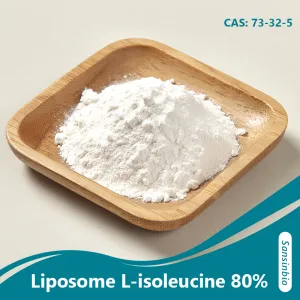
Liposomal L-Isoleucine 80% High Bioavailability Muscle Recovery and BCAA Balance Supplement
Category: OthersBrowse number: 84Number:Release time: 2026-10-20 21:43:45Product Summary Liposomal L-Isoleucine 80% is a high-purity, liposomal-encapsulated form of L-isoleucine—one of the three branched-chain amino acids (BCAAs) and a critical substrate for muscle protein synthesis, glucose regulation, and hemoglobin formation—standardized to ≥80% active content. L-Isoleucine is an essential amino acid that cannot be synthesized endogenously and must be obtained through diet or supplementation. As a BCAA, isoleucine is broken down for energy within muscle tissue and is essential for muscle growth and protein synthesis. It helps promote muscle recovery after exercise and may reduce post-exercise muscle soreness and markers of muscle damage when taken as part of a BCAA supplement. Isoleucine is also needed for hemoglobin formation and helps regulate blood glucose levels. However, traditional free-form L-isoleucine relies on saturable active transport systems in the small intestine, and high doses quickly saturate these carrier proteins, leaving a substantial portion unabsorbed and resulting in low systemic bioavailability. Additionally, isoleucine competes with leucine and valine for both absorption in the gut and entry into muscle tissue. Liposomal encapsulation within a phospholipid bilayer addresses these fundamental limitations. A stability study of isoleucine-containing bioactive peptides demonstrated that liposomal nanovesicles achieved high encapsulation efficiency, with encapsulation efficiency of isoleucine-proline-proline (IPP) in liposomal vesicles maximized through optimized preparation methods. Liposomal L-isoleucine utilizes a biomimetic delivery mechanism to bypass physiological absorption barriers, ensuring more of the active nutrient reaches the bloodstream and muscle cells. This water-dispersible powder is suitable for capsules, functional beverages, and nutritional formulations targeting muscle recovery, energy metabolism, and athletic performance. Each batch is HPLC-standardized and quality-tested for purity, identity, and L-isoleucine content.
News
Category:
No search results found!
Case
Category:
No search results found!
Video
Category:
No search results found!
Download
Category:
No search results found!
Job
Category:
No search results found!
Featured Products
No search results found!



 Phone