
 Español
 Français
 Deutsch
 日本語
 한국어


What are liposomes
Liposomes are tiny spherical vesicles made from one or more layers of phospholipids, the same kind of molecules that form cell membranes in living organisms. Because of this structure, liposomes can resemble natural biological membranes very closely. They usually have an aqueous core inside and a lipid bilayer surrounding it. This special design allows liposomes to carry both water-soluble substances inside the core and fat-soluble substances within the membrane layer. As a result, they are widely studied and used in medicine, pharmaceuticals, cosmetics, and scientific research.One of the most important features of liposomes is their ability to act as delivery vehicles. They can protect sensitive ingredients from degradation caused by light, oxygen, enzymes, or the acidic environment of the body. This makes them useful for transporting active compounds to specific sites. In medicine, liposomes are often explored for drug delivery because they may improve the stability, absorption, and controlled release of medicines. They can also reduce irritation or side effects by helping certain substances reach the target area more efficiently. In some cases, liposomes are designed to release their contents slowly over time, which can help maintain a steady effect.Liposomes can vary in size, number of layers, and composition. Some are very small and contain a single lipid bilayer, while others are larger and have multiple layers. Their physical properties can be adjusted by changing the type of phospholipids, cholesterol content, surface charge, or preparation method. These differences influence how long liposomes remain in the body, how easily they enter cells, and how stable they are during storage and use. Scientists can also modify the surface of liposomes to improve targeting or reduce recognition by the immune system.In addition to medicine, liposomes are popular in skincare and personal care products because they can help deliver moisturizing agents, vitamins, and other active ingredients into the skin. Their membrane-like structure may improve penetration and enhance the effectiveness of certain compounds. In laboratories, liposomes are used as model systems to study cell membranes, molecular interactions, and transport processes.Liposomes are generally considered versatile and promising because they combine biocompatibility with strong delivery potential. However, they also have limitations. Some liposomes can be unstable during storage, may leak their contents, or require careful manufacturing conditions. Researchers continue to improve their design to make them more durable, efficient, and precise. Overall, liposomes are an important scientific and technological tool with broad applications across many fields.
Products
Category:
-
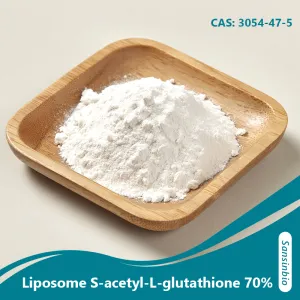
Liposomal S-Acetyl-L-Glutathione 70% High Bioavailability Intracellular Glutathione Precursor Supplement
Category: OthersBrowse number: 52Number:Release time: 2026-10-20 20:40:07Premium Liposomal SAG 70% Cellular Detoxification and Skin Brightening Formula Product Summary Liposomal S-Acetyl-L-Glutathione 70% is a high-purity, liposomal-encapsulated form of S-acetyl-L-glutathione (SAG)—a chemically modified, highly bioavailable derivative of reduced L-glutathione in which the thiol group of the cysteine residue is acetylated—standardized to ≥70% active content. SAG is the S-acetylated bioavailable form of L-glutathione (L-GSH) in its reduced form, obtained through chemical synthesis and presented as a white or almost white crystalline powder with HPLC assay ranging from 97.0% to 102.0% on the dry basis. Unlike native glutathione, which is rapidly degraded by γ-glutamyl transpeptidase (γ-GT) in the gastrointestinal tract and has poor oral bioavailability, SAG's acetyl group protects the thiol moiety from enzymatic degradation, enabling direct cellular uptake and intracellular conversion to GSH by cytosolic thioesterases. Compared with glutathione and other glutathione derivatives, SAG exhibits better stability, faster onset of action, higher bioavailability, and superior safety. Liposomal encapsulation within a phospholipid bilayer provides an additional layer of protection, shielding SAG from premature degradation during digestive transit and further enhancing cellular delivery. This water-dispersible powder is suitable for capsules, functional beverages, and nutritional formulations targeting antioxidant defense, detoxification, and skin health. Each batch is HPLC-standardized and quality-tested for purity, identity, and SAG content.
News
Category:
-
[Info]Breakthroughs in Liposome Technology Redefine Precision Drug...
2026-10-20 20:11:20
Case
Category:
No search results found!
Video
Category:
No search results found!
Download
Category:
No search results found!
Job
Category:
No search results found!
Featured Products
No search results found!



 Phone