
 Español
 Français
 Deutsch
 日本語
 한국어


Palmitate
Palmitate is a term commonly used to describe salts and esters of palmitic acid, a saturated fatty acid with 16 carbon atoms. It is derived from palmitic acid, which occurs naturally in many plants and animals and is one of the most abundant fatty acids in the human body. Because of its chemical structure, palmitate is widely used in various industries, including food, cosmetics, pharmaceuticals, and personal care products.In chemistry, palmitate refers to the anion formed when palmitic acid loses a hydrogen ion. This form can combine with different metals or organic molecules to create a variety of compounds, such as sodium palmitate, calcium palmitate, and ascorbyl palmitate. These compounds often have distinct functions depending on their structure and application. For example, some palmitate salts are used as emulsifiers, stabilizers, or texture modifiers, while certain palmitate esters serve as sources of fatty acids or antioxidants.One of the most familiar uses of palmitate is in the food industry. Palmitate-based ingredients may help improve texture, extend shelf life, and enhance the stability of food products. They can act as emulsifying agents, helping water and oil mix more evenly in processed foods. In nutritional products, palmitate derivatives may also be used to deliver fat-soluble vitamins more effectively, since the palmitate form can improve solubility or stability under certain conditions.Palmitate is also important in skincare and cosmetics. Because palmitic acid is naturally found in the skin’s lipid barrier, palmitate derivatives are often used in creams, lotions, and other personal care formulations. They can help create a smooth feel, reduce moisture loss, and improve product consistency. Some palmitate esters are valued for their ability to soften the skin and enhance the spreadability of formulations. In addition, their relatively stable nature makes them useful in products that need to maintain quality over time.In pharmaceuticals, palmitate compounds can be used to modify the properties of active ingredients. By attaching a palmitate group to a molecule, manufacturers may improve its absorption, stability, or storage life. This is especially useful for substances that are sensitive to oxidation or that need a slower release profile. Palmitate forms are therefore often chosen when a more controlled or stable delivery system is desired.Palmitate also plays a role in biology and nutrition. As a component related to dietary fats, it is involved in energy storage and cellular structure. However, like many fatty acids, its effects depend on overall dietary balance and context. In nature, palmitate is found in palm oil, dairy products, meat, and certain plant oils. It is a basic building block used by the body to create more complex lipids.Overall, palmitate is a versatile and widely used chemical form of palmitic acid. Its usefulness comes from its stability, functional flexibility, and compatibility with many formulations. Whether in food, skincare, or medicine, palmitate contributes to product performance, texture, and stability in many practical ways.
Products
Category:
-
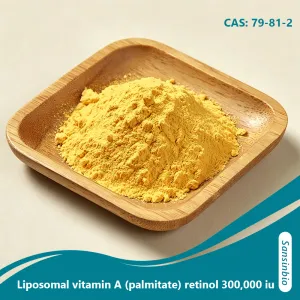
Liposomal Vitamin A Palmitate 300K IU High Bioavailability Retinyl Palmitate Supplement
Category: VitaminsBrowse number: 35Number:Release time: 2026-10-20 20:10:06Premium Liposomal Vitamin A Palmitate 300K IU Vision and Immune Support Formula Product Summary Liposomal Vitamin A Palmitate 300K IU is a high-purity, liposomal-encapsulated form of retinyl palmitate (vitamin A palmitate)—the most stable ester form of preformed vitamin A and the most common form of vitamin A used for dietary supplementation—standardized to 300,000 IU/g (approximately 90,000 μg RAE/g). Retinyl palmitate is a fat-soluble vitamin A ester formed by the condensation of palmitic acid with all-trans-retinol. It binds to and activates retinoid receptors, thereby inducing cell differentiation and decreasing cell proliferation, and is essential for vision, immune function, reproduction, and cellular differentiation. However, native retinyl palmitate is highly susceptible to oxidative degradation and has limited aqueous dispersibility, which restrict its bioavailability and formulation flexibility. Liposomal encapsulation within a phospholipid bilayer addresses these fundamental limitations. Liposome-encapsulated vitamin A compounds exhibit greater stability and diminished toxicity compared to free forms, with studies demonstrating that these systems reduce blood viscosity and cause less lysis of red blood cells than retinoid compounds not complexed in liposomes. Retinyl palmitate-loaded nanoliposomes achieved particle sizes in the range of 76–115 nm with monomodular distribution, and incorporation of cholesterol and vitamin A palmitate increased the zeta potential from −29 to −58 mV, significantly improving electrostatic stability. This water-dispersible powder is suitable for capsules, functional beverages, and food fortification targeting vitamin A supplementation, vision support, immune function, and skin health. Each batch is HPLC-standardized and quality-tested for purity, identity, and vitamin A activity.
News
Category:
No search results found!
Case
Category:
No search results found!
Video
Category:
No search results found!
Download
Category:
No search results found!
Job
Category:
No search results found!
Featured Products
No search results found!



 Phone