
 Español
 Français
 Deutsch
 日本語
 한국어


PABA
PABA (para-aminobenzoic acid) is a naturally occurring organic compound that belongs to the family of aromatic amines and carboxylic acids. It is a white to light yellow crystalline substance that is only slightly soluble in water but more readily dissolves in alcohol and other organic solvents. Because of its simple molecular structure, PABA has attracted attention in chemistry, biology, and industry for many years. It is best known as a precursor in the biosynthesis of folic acid in microorganisms and plants, where it plays an important role in the formation of essential metabolites. In nature, PABA can be found in small amounts in foods such as whole grains, eggs, milk, and meat, although it is usually present in very low concentrations. In biological systems, bacteria use PABA to synthesize folate, an important vitamin-like compound required for DNA production, cell division, and growth. Humans do not rely on PABA in the same way because folate must be obtained from the diet. This difference has made PABA especially interesting in medical and nutritional research. PABA also has a long history of use in personal care products. It was once widely included in sunscreens because it can absorb ultraviolet B (UVB) radiation. However, over time, concerns about skin sensitivity, staining, and allergic reactions reduced its popularity in many formulations. Even so, its UV-absorbing property remains an important part of its chemical identity. PABA derivatives are still used in some applications where light absorption, stability, or intermediate chemical reactivity is desired. From an industrial perspective, PABA is valuable as a building block in the synthesis of dyes, pharmaceuticals, and specialty chemicals. Its amino group and carboxylic acid group make it versatile for further chemical modification. Chemists often use it as an intermediate in the preparation of more complex molecules. The compound’s reactivity allows it to participate in reactions such as esterification, diazotization, and amide formation, which expand its usefulness in synthetic chemistry. Safety and handling are important when working with PABA. Although it is generally considered low in toxicity under normal conditions, it may cause irritation or allergic reactions in sensitive individuals. Proper storage in a cool, dry place away from strong oxidizing agents helps maintain its stability. In laboratory settings, standard protective measures such as gloves and eye protection are recommended. Overall, PABA is a small but significant molecule with applications spanning biology, chemistry, and product formulation. Its role in folate synthesis, UV absorption, and chemical synthesis has made it an important compound in both scientific study and practical use.
Products
Category:
-
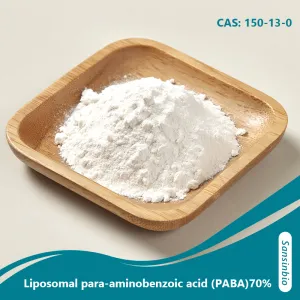
Liposomal Para-Aminobenzoic Acid PABA 70% High Bioavailability Cellular Antioxidant and Neurotransmitter Support Supplement
Category: OthersBrowse number: 44Number: liposomal PABARelease time: 2026-10-20 20:11:07Premium Liposomal Para-Aminobenzoic Acid 70% Skin, Hair and Cellular Health Formula Product Summary Liposomal Para-Aminobenzoic Acid PABA 70% is a high-purity, liposomal-encapsulated form of para-aminobenzoic acid (PABA)—a naturally occurring aminobenzoic acid historically classified as a member of the vitamin B complex and recognized for its role in folate synthesis, neurotransmitter modulation, and antioxidant defense—standardized to ≥70% active content. PABA, also known as 4-aminobenzoic acid or vitamin B10, is an organic compound with the formula H₂NC₆H₄CO₂H that is found naturally in foods including grains, eggs, milk, and meat. It serves as a precursor in the biosynthesis of folate and is a structural component of folic acid and certain coenzymes. Emerging experimental and clinical evidence demonstrates that PABA exhibits multifaceted therapeutic potential through its roles in neurotransmitter modulation, anti-inflammatory action, and antioxidant defense, enhancing serotonin and dopamine synthesis by activating key enzymes including tryptophan hydroxylase and tyrosine hydroxylase. However, native PABA faces absorption limitations due to its relatively poor water solubility and rapid renal clearance. Liposomal encapsulation within a phospholipid bilayer addresses these fundamental limitations. Liquid crystal-drug formulations of PABA have demonstrated significantly improved bioavailability compared to PABA solution alone. This water-dispersible powder is suitable for capsules, functional beverages, and nutritional formulations targeting cellular health, antioxidant defense, and skin and hair support. Each batch is HPLC-standardized and quality-tested for purity, identity, and PABA content.
News
Category:
No search results found!
Case
Category:
No search results found!
Video
Category:
No search results found!
Download
Category:
No search results found!
Job
Category:
No search results found!
Featured Products
No search results found!



 Phone